
“The world we see is a reflection of the world we believe in.”
— Wayne Dyer
What If It’s Not the World — But Your Thinking?
What if your experience of life wasn’t determined by what’s happening — but by what you’re thinking? This article explores how understanding the nature of Thought can radically shift your mental well-being, with insights from the Three Principles, neuroscience, and lived experience.
What Is Thought? A Foundational Principle of Human Experience
What is thought? Where does it come from? And how can something invisible have so much power over how we feel, behave, and even heal?
Let’s take a journey — through the spiritual and scientific nature of thought, how it shapes our wellbeing, how we can see beyond its illusions, and ultimately how we can return to the peace that is always within us.
In the silence behind our thinking, a quiet truth waits to be discovered: our moment-to-moment experience is not created by our circumstances, but by our thoughts.
Thought is the invisible energy behind every moment of human experience — not just an idea in the mind, but the creative force that colors everything we feel, perceive, and act upon.
Sydney Banks, the originator of the Three Principles, described Thought not as something the brain produces, but as the spiritual power that allows thinking to happen.
“Thought is not reality; yet it is through Thought that our realities are created.”
— Sydney Banks, The Missing Link
Sydney Banks, spoke of Mind, Consciousness, and Thought as the spiritual essence that shapes all human experience.
Mind is the intelligence behind life.
Consciousness is our capacity to be aware.
Thought is the invisible energy that forms our experience.
Living from the Inside-Out
Every feeling we have — joy, sorrow, stress, love — is birthed through Thought, animated by Consciousness, and powered by Mind.
This means our lives are lived from the inside out, not the outside in. It’s not what happens that determines how we feel, but what we think about what happens. This perspective doesn’t invalidate our emotions — it reveals their source. It shows us how the inner world shapes the outer experience, and not the other way around.
We aren’t broken — we’re just caught in thought!
The Monster in the Room: How Thought Creates Illusions
There’s a metaphor I first heard during a workshop called The Space Where Miracles Happen with Michael Neill and Dicken Bettinger. It captures the essence of how thought works better than any theory:
Imagine this:
You walk into a child’s room at night and hear them whisper, “There’s a monster!” You look through the window — and for a moment, you see it too. A hulking shape by the curtain, looming and strange.
But then you get closer. And what looked like a monster is actually a teddy bear, softly lit by moonlight, casting long shadows across the wall.
That’s what our thoughts do.
They cast shadows. They paint monsters. And when we believe the shapes without questioning the light that formed them, we react as if the threat is real.
Our experience — fear, anxiety, sadness — feels real because it is real in the moment. But the source isn’t the teddy bear. It isn’t the world outside us. It’s the way our thinking interprets what’s in front of us.
“Thought is the artist’s brush that paints the canvas of our lives.” — Sydney Banks
The moment we see it for what it is — just thought — the shadows dissolve. Not because we fixed them. But because we stopped believing the monster was ever real.
The Neuroscience of Thought: Survival, Stress, and Healing
While the spiritual insight is freeing, modern neuroscience helps us understand the mechanics behind it. Thought doesn’t just shape feelings — it directly impacts the body and brain.
The Body Reacts to Imagined Stress
Our neocortex, or “thinking brain”, gives us the unique human ability to imagine, worry, predict, and ruminate. But the brain doesn’t distinguish between a real threat and a vividly imagined one. When we obsess over a problem or replay a painful memory, our nervous system responds as if it’s happening now.
What Happens in the Body?
- Cortisol and adrenaline flood the system
- The immune system is suppressed
- Inflammation increases
- The heart races
- Digestion slows
- Muscles tighten
Over time, repeated stress from thought alone can lead to physical illness — including autoimmune conditions, digestive disorders, anxiety, insomnia, chronic stress, and even heart disease.
Can Thought Affect Biology?
As researchers like Dr. Bruce Lipton and Dr. Joe Dispenza suggest, thoughts influence gene expression and immune function through prolonged stress responses. When the body is repeatedly flooded with stress hormones, the immune system weakens and biological balance is disrupted.
In survival mode, your focus narrows. Stress hormones keep you locked onto the perceived threat. If the emotional reaction lingers for hours — it’s called a mood. If it lasts weeks — it becomes temperament. If it lasts years — it becomes a personality trait. “If your thoughts can make you sick… is it possible that your thoughts can help you heal?”
Science says yes — because the brain is plastic. You can literally recondition your biology by breaking free from the prison of over-identifying with your thoughts.
You Are One Thought Away
Michael Neill, in The Inside-Out Revolution, puts it simply:
“You’re only one thought away from happiness… and one thought away from sadness.”
That distance? It’s a blink. A moment of awareness. A simple shift in perspective — and everything changes.
We tend to believe that:
“Life made me anxious.”
“They made me angry.”
“The situation made me sad.”
But what we’re actually responding to is the meaning we give it — through thought.
We’re living in the feeling of our thinking, not in the feeling of life itself.
Your experience of life changes with your thinking — moment to moment. It means you are never truly stuck. You are not broken. You are not your pain, or even your emotions.
You are the space in which thought flows.
Peace Is Closer Than You Think
The space between suffering and peace is often no more than a single thought — believed or let go. That’s how close you always are to your natural wellbeing.
So often we believe that our happiness lies in fixing our circumstances, changing other people, escaping the situation. But the inside-out understanding reveals something far more empowering: what we seek is not out there. It is already within us — buried beneath layers of thought.
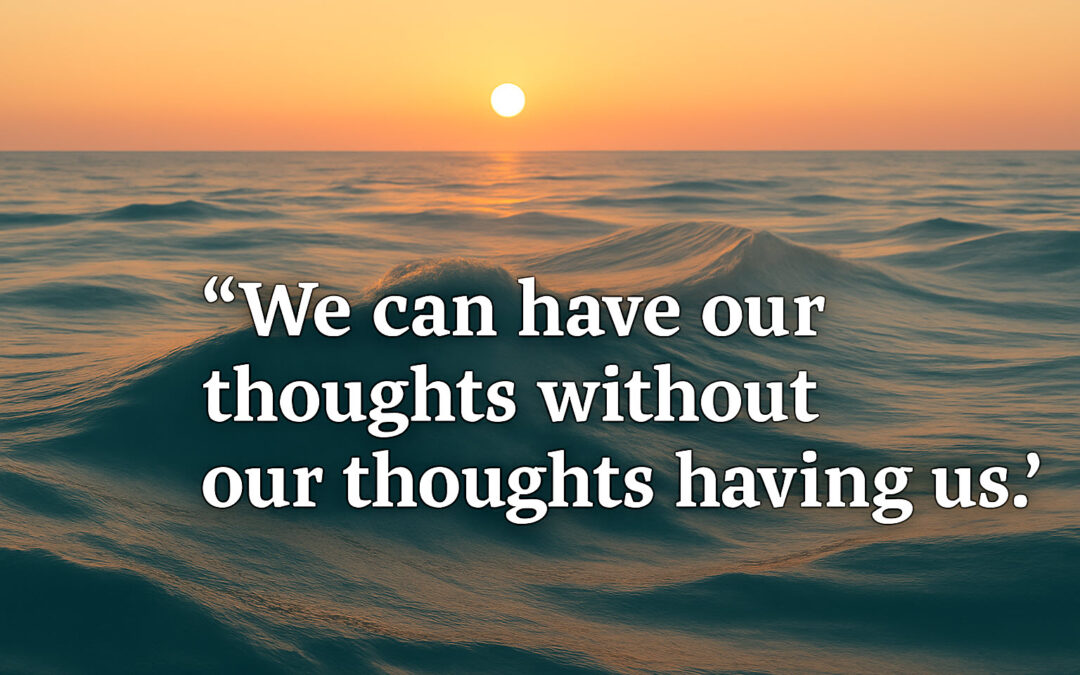
As Sydney Banks so beautifully put it, “We can have our thoughts without our thoughts having us.”
We don’t need to control what we think. We just need to see thought for what it is: a passing, creative force — not a permanent truth. When we stop giving our thoughts so much weight, we return to the clarity that was always there.
My Personal Turning Point: From Struggle to Stillness
When I moved to the UK, I encountered a wave of emotional struggle I didn’t expect. New systems, cultural differences, language challenges — all manageable. But what overwhelmed me wasn’t the outer reality. It was the inner noise.
I found myself stuck in loops of thinking: “I’m not good enough,” “They’ll judge me,” “I’ll fail.” I replayed these over and over until they became background music in my head and they consumed me. I couldn’t sleep. My emotional wellbeing crumbled. And for a long time, I believed that my distress was caused by other people or outside events.
My mental health began to suffer. And I believed it was because of everything around me.
I blamed the world.
I blamed others.
I believed my experience was caused by my circumstances.
Then I came across the work of Sydney Banks and the Three Principles. For the first time, I saw: it’s not the world that creates my experience — it’s Thought.
Not every thought is true.
Not every fear needs to be believed.
As I saw the illusion, it lost its grip.
My well-being began to return.
Peace — not the peace I tried to create, but the peace that was always there — came forward.
I still have insecure thoughts. I still catch myself in self-criticism. But now I see it. I don’t get lost in it. I remember that all feelings come from thought — and thought always moves.
I began to return home to myself. To stillness. To clarity.
The Human Gift: Free Will and Thought Awareness
There is something profound about being human. Unlike any other species, we can notice our thinking. We can reflect, observe, and choose. We can hold a thought or let it go.
We are not prisoners of thought — unless we believe we are.
“Among the greatest gifts given to us are the powers of free thought and free will… Yet the same gifts can become our greatest weakness. We often lack the strength to change our minds, and so we get stuck in the negative thoughts and behaviours of the past.”
— Sydney Banks, The Missing Link
This means we don’t have to chase good thoughts or run from bad ones. We don’t have to think our way into peace.
We just need to see how thought works.
That insight alone loosens the grip. It reconnects us with who we truly are beneath the noise — aware, whole, and deeply well.
Coming Home to Clarity
There is a metaphor often used in the Three Principles: imagine a pond. When wind stirs the water, it ripples and distorts the reflection. But when the wind stops, the water calms — and the reflection returns, clear and still.
Thought is like the wind. It churns the surface of our minds. But the stillness is never gone — just temporarily hidden. And when thought subsides, clarity returns by itself.
You don’t need to “think better.”
You don’t need to fix your thoughts.
You just need to see that they’re not permanent — and they’re not you.
Beneath the swirl of worry, fear, stress, and judgment, you are still whole. You are still home — and always just one thought away from returning.
And when your mind quiets, your natural wellbeing returns.
Because underneath it all, you are already okay.
Sources and Inspirations :
The Missing Link by Sydney Banks
The Enlightened Gardener by Sydney Banks
The Inside-Out Revolution by Michael Neill
Coming Home by Dr. Dicken Bettinger & Natasha Swerdloff
Workshops: A User’s Manual for Human Being — Michael Neill
The Space Where Miracles Happen — Michael Neill & Dicken Bettinger
Coaching tools and reflections from Neuro-Linguistic Programming (NLP) and Positive Intelligence.
Neuroscience insights from Dr. Joe Dispenza, Dr. Bruce Lipton
If this resonates with you and you’d like to explore these ideas further through coaching or hypnosis, I’d love to connect. You are never more than one insight away from transformation.